
Dear Friends:
Spring Training, 2014
Last month, I told you I’d write about our three days in Arizona for spring training.
It was a glorious family occasion, nine of us converged from Chicago, Los Angeles, Seattle, and Indio in the California desert… a rare treat in many ways.
As Bill Veeck was so fond of saying, spring training is the most wonderful time of the year. “It’s the Garden of Eden… forget about last year,” as he commented on our TV show, Time Out: This season’s going to be great.
I’ve been to spring training about six times. But none this century. It used to be loose, cheap, and noncorporate. The ball players talked casually with the fans…even during the games.
Not so any more.
The Cactus League has become an industry. When we got off the plane in Phoenix, we were inundated with promotional materials, maps, and hype about the 14 teams spread around the area. In the hotel where we stayed, there were at least 300 people sporting MLB-certified hats, jerseys, and paraphernalia for their various teams. The “training camps” have become multi-acre real estate complexes with 12 practice diamonds, batting cages, pitchers’ and catchers’ cages, and free-standing souvenir stores. The Sox/Dodger complex even has a five acre Arizona faux “water feature” next to the ball park that seats over 13,000.
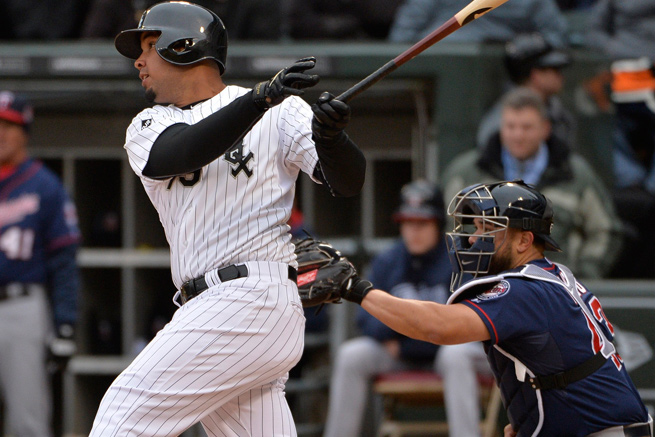
But, it’s still baseball and we all still love it…what an absolute thrill to get the first look ever at a player we KNOW will be a Hall-of-Famer like José Abreu,* White Sox first baseman who immigrated from Cuba over the winter; and such a retro kick from an enthusiastic old-fashioned hustling rookie center fielder like Adam Eaton (seen in this picture with matching mustachioed fan, our son, Jesse).
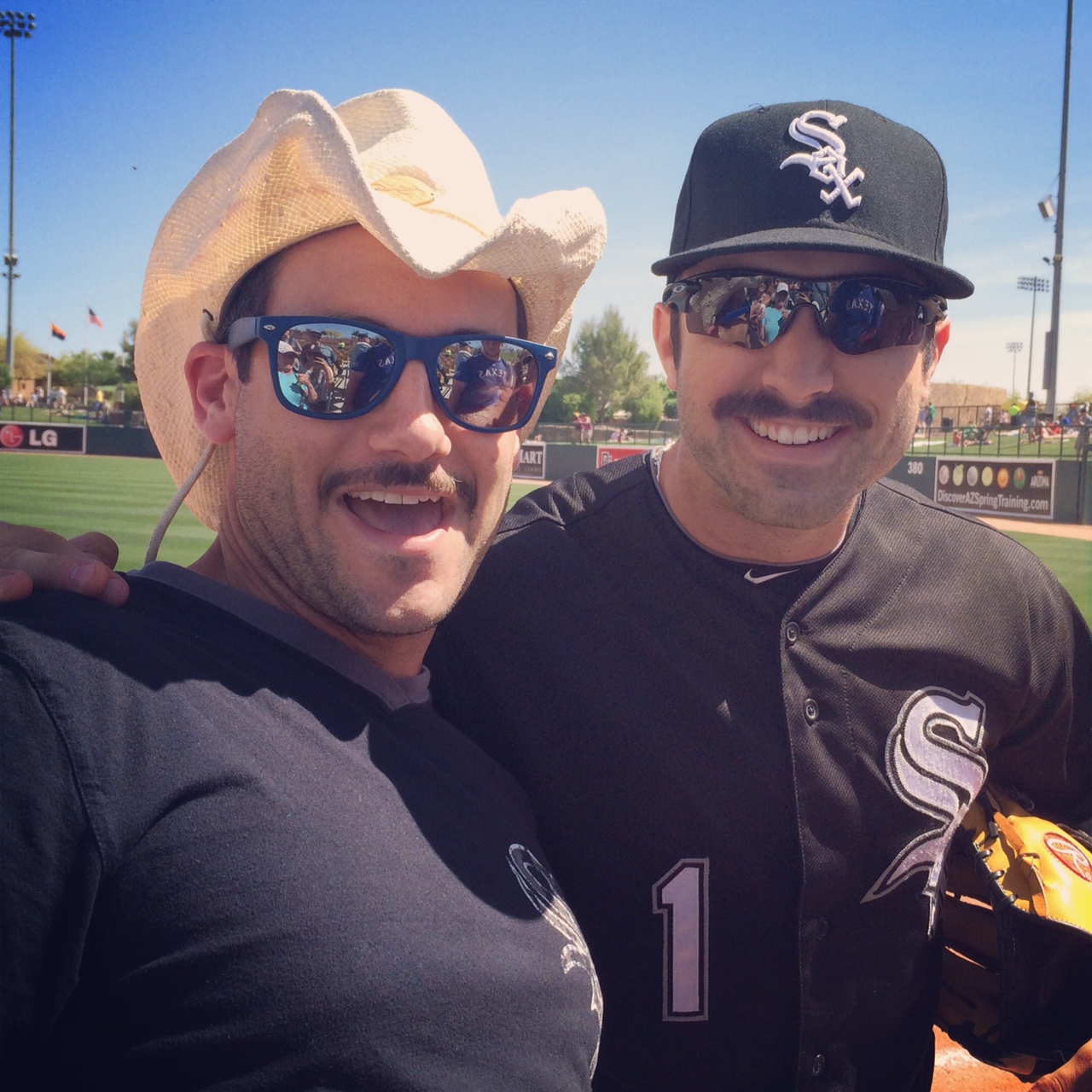
So, even if each ticket cost $25 or $30 and a beer was $7.50, the family and baseball made it a joy. I’d definitely go again—but possibly not until the 2020’s.
*[Update, April 10:
Abreu has hit four home runs in three games this week. He’s had the best first 10 games of any Sox player since Ron Kittle in 1983…a .300 batting average, a .720 slugging percentage and 14 RBIs.]
From the Weinberg House Organ, 1954
As I frequently do these days, I checked out the (Louis, Jr.) Weinberg House Organ for inspiration and perspective for this revival effort. From October 28, 1954, I found some items that triggered the roots of my interest in both baseball and economics. Enough baseball for now, but here’s one my dad wrote about a little trip he took to visit a former college professor, I. Leo Sharfman, (a man I met for the first time at a Philadelphia Athletics’ spring training game in West Palm Beach, FL in 1954.)

And, yes, now, almost 60 years later, I really understand what my dad was writing about.
Everybody Talks about the Fed, but…
Sharfman was an econ icon. I‘m not in the habit of telling everyone, but I somehow managed to get an undergraduate degree in economics form University of Michigan. Plus an MBA degree from NYU. The schools were excellent. I didn’t live up to their standards. But, when I paid attention to my studies, the Federal Reserve was always a major topic.
So, here are a few thoughts about the current situation from a guy who probably knows and remembers a fraction of what I was spozed to learn in the 1960’s. (There were plenty of distractions!)
The Fed, under both Ben Bernanke, (PhD Econ, MIT, 1979) and Janet Yellin (PhD, Econ, Yale, 1971) has been constantly involved in “Quantitative Easing.”
In plain language, “QE” means buying long-term paper debt of US, with the goal of lowering interest rates and revitalizing the wounded U.S. economy. It’s commonly referred to as “printing new money,” and inserting those dollars into the banking system. That process has been used by the Fed every month since the economic crisis of 2007.
OK, the U.S. federal debt has increased by trillions since QE started. It’s now over $17 TRILLION, about half of which is owed to the Fed and U.S. government agencies (China owns “only” about $1.3 Trillion of the debt).
There are as many interpretations of the effects of this as there are experts, but I find it difficult to argue with those who say that if the Fed keeps on borrowing and printing money, those dollars will have to be worth relatively less, eventually…it’s inflation by any other name.
So what? So, it seems like we’ll have to pay the piper some time.
And it could be soon. Many sensible analysts say that it probably means that just about every dollar we (individuals, corporations, and governments) have to pay for everything we buy will cost more dollars. And it’s not likely to help the value of U.S. stocks, either. That’ s a spiral that almost nobody (with possible exception of the countries whose governments own the bonds) will benefit from in the long run.
But, one thing I DO remember from college was a quote from the great economic genius, John Maynard Keynes about long term forecasting:
“In the long run, we’ll all be dead.”
On Being “Slightly Famous”
As usual, I‘ve included some thoughts related my book-in-progress, Media Burn (what one professor/friend has called “The Effects of Being Seen on TV and Video Screens.”) This edition’s quote was written in 2005 by Joseph Epstein, essayist, and author of more than 20 books. For more than twenty years, he wrote for and edited The American Scholar.
“You’re slightly famous, aren’t you, Grandpa?” my then eight year old granddaughter once said to me.
“I am slightly famous, Annabelle, “ I replied, “except no one quite knows who I am.”
The only large, lumpy kind of big-time celebrity available, outside movie celebrity, is to be had through appearing fairly regularly on television. I had the merest inkling of this fame when I was walking along one sunny morning in downtown Baltimore, and a red Mazda convertible screeched to a halt, the driver lowered his window, pointed a long index finger at me, hesitated, and finally, the shock of recognition lighting up his face, yelled, “C-SPAN !”
…“The best criterion I’ve yet come across holds that you are celebrated, indeed famous, only when a crazy person imagines he is you. It’s especially pleasing that the penetrating and prolific author of this remark happens to go by the name of Anonymous.”
I can see a current example of the impact from appearing on TV…Media Burn, or at least, incipient MB.
CNN is in the midst of an eight-hour, eight-week documentary TV series, Chicagoland. It’s actually a mongrel blend of forced-reality TV, a puff piece for Mayor Rahm Emanuel, and documentary, but that’s a topic for another time.
One of the featured characters is the dynamic principal of Fenger High School located in Chicago’s Roseland neighborhood where gangs, violence and murders are constant undercurrents.
Elizabeth Dozier (referred to as “Liz” by CNN) has had four successful years turning around the academics, culture, and community of the school. Her commitment is unquestionable. She’s attractive in many ways, charismatic, constantly on the move, an unswerving advocate for her students, and a survivor of a single-mother household with a dad who had been in jail. She is portrayed in the most favorable ways possible on the CNN series.
The programs air on Thursday nights. Two weeks ago Thursday (at the exact time #2 was airing), Dozier was at the Chicago Bulls’ game at United Center with one of her students and a dean from Fenger. She was introduced on the PA and they were shown on the Jumbotron so all 22,000+ could see them. The crowd cheered loudly for them for about 20 seconds. On TV, she got the Spike Lee-Jack Nicholson front-row treatment.
So, within one week’s time, Liz Dozier had become one of Chicago’s brightest stars…a celebrity of significance. It will be with her for all her days. She probably wants it, for her needy school and for herself, but from now on, she has no choice. She’s out there.
One way or another, she will always have to deal with Media Burn, for better and for worse.
We Get Letters
This one came from “Tommy Chicago,” Tom Palazzolo, one of the greatest Chicago characters and long-time friend, pioneer filmmaker and artist. It’s his take about on-air anchors.
“Thanks for your book excerpt, insightful stuff. That box that never sleeps can be so many things to those in it and those of us outside looking in.
One day walking down State street I stopped in front of channel 2 window and watched the anchor man and woman who were on air. As soon as the camera cut to the commercial their faces froze and became in some strange way, vacant, never glancing out at the ‘little people” on the other side of the window who were staring and waving. Once back on air they were miraculously reanimated. Wonder what it’s like to be in their shoes. Creepy I suspect.”
That does it for another edition. In the time between when I finish typing and formatting this and when I hit the SEND button (~ 1 minute), there will be at least:
–571 new websites created
–70 new domains registered
–20,000 photos posted to Tumblr and
–278,000 new tweets.
It IS a mad, mad, mad, mad digital world. Where’s Jonathan Winters when we really need him?
March weather in Chicago was as difficult and unrelenting as any I can remember. But, ah, it’s finally spring and all’s right with the world!
I hope it will be in yours too.
 PY-O-MY