
Here’s to change in 2023. And growth. And health.
We experienced the beginning of the year from Brooklyn in New York.

Ah, Brooklyn, I lived there almost 60 years ago. There’s still some resemblance,
But neither it nor I am the same. As with most feelings, it’s many-layered: first, the joy of good times of discovery renewed on this trip. But also, a tinge of not being a New Yorker anymore. Some, the satisfaction with the life/lives I’ve had since, coupled with the realization it can never be the same.
For the first edition of the new year, I’m uncovering stuff I don’t know, which I realize, could be the most elemental stuff to others of different ages and digital awareness.
Maybe you don’t know as much as I don’t…some are factoids (a term coined by Norman Mailer in 1973 in his biography or Marilyn Monroe) and some are just images and impressions. Enjoy.
How Stuff Gets Around
I marvel at how stuff gets to where it’s going here in the USA. About 40% is on trucks, 28% on trains, 17% pipelines, mail and other modes 8%, water 7%, and air .1%. Judging from all the FedEx trucks and packages delivered everywhere, I never would have guessed that air is just a tiny blip. And everywhere you go, there’s an Amazon truck.
It turns out that shopping online actually went down last year.
For me, it went up. I get less kick from shopping in stores and buying stuff than I ever did. Maybe because I’m a Christmas curmudgeon (which I am) or just because there’s so much stuff all over the place, being part of the hordes of buyers has very little appeal. Unlike almost everyone under 35, I watch TV…I use the remote to battle commercials every day, especially on DVR. The media are all about selling us stuff. If it didn’t work, they wouldn’t do it. Commercials on TV still work…that’s why the majority of the money that politicians raise goes to buying time on TV.
Unwanted commerciality online has even more annoying effects. I can’t read or watch what I want for “free” without paying the price of seeing ads for something related to something I bought a while ago. It’s not news that Google/Instagram, Facebook, etc. generate huge amounts of profit from selling information about users to anyone who wants it. It’s not a revelation that the sophistication of algorithms has grown exponentially without stopping.
A decision in Europe just this week might change the way social media companies can use the information they generate. They might even be forced to give users an obvious choice to opt-out. That would be amazing and justified, but don’t ever bet against Google…they have their ways.
They Be Workin on the Railroads
No big shock, but China has more high-speed rails there than the rest of the world combined Their plan Is to double the amount of track and traffic in China in the next three years. By 2026, they plan to have more train tracks and trains than the US which is the only country with more right now.
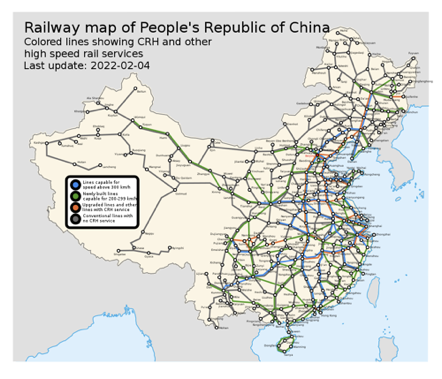
Study this…we’ll have a quiz next month
The remarkable Louis Armstrong
On the four-day trip, we saw some great museums and shows. Next time I’m n New York, I want to go to the Louis Armstrong House Museum in Queens where he lived modestly for the last 28 years of his life with his wife Lucille. Many thousands of his personal recordings and memorabilia tracing significant parts of the history of jazz are in the house, designated as a National Historical Landmark. He was ahead of his time as a musician, humanitarian, and unique character. He led by example, the best way.
Here he is, playing for his wife, in Egypt, 1961

Lists for the end of 2022
15 Most-Viewed Sites in the US, 2022
YouTube
Wikipedia
Amazon
Google Play
Live.com (Microsoft Outlook)
IMDB
Fandom
Apple
Netflix
MSN
YouTube Stats:
More Views than any Other Site
2.6 Billion Videos Viewed Every Month
India has the most viewers 467 Million
500 Hours of Video Uploaded Every Minute
Global Searches
These were the most-searched terms globally in December:
- Wordle
- India vs England
- Ukraine
- Queen Elizabeth
- Ind vs SA
- World Cup
- India vs West Indies
- iPhone 14
- Jeffrey Dahmer
- Indian Premier League
Top ten Searches in the US:
- Wordle
- Election results
- Betty White
- Queen Elizabeth
- Bob Saget
- Ukraine
- Mega Millions
- Powerball numbers
- Anne Heche
- Jeffrey Dahmer
The most visited websites worldwide according to “Top Websites Ranking” lists published by Similarweb, December 2022,
| Site | Category | Principal country/territory |
| Google Search | Search Engines | United States |
| YouTube | Streaming & Online TV | United States |
| Social Media Networks | United States | |
| Social Media Networks | United States | |
| Social Media Networks | United States | |
| Baidu | Search Engines | China |
| Wikipedia | Dictionaries and Encyclopedias | United States |
| Yandex | Search Engines | Russia |
| Yahoo | News & Media Publishers | United States |
| Social Media Networks | United States | |
| xVideos | Adult | Czech Republic |
| Amazon | eCommerce & Shopping > Marketplace | United States |
| Pornhub | Adult | Canada |
| Xnxx | Adult | France |
| Live | Email (MSN Outlook) | United States |
| Yahoo JP | News & Media Publishers | Japan |
| Netflix | Streaming & Online TV | United States |
| TikTok | Social Media Networks | China |
Trivia Question
Who’s the most popular (most followers) on TikTok who wasn’t a celebrity when he started?

Answer: Khaby Lame.
I didn’t know anything about Khaby until last month. (I’ve been in a kryptonite digital cave.) He’s 22, Sengalese-born Italian who had five of the top ten most-watched Instagram reels in 2022. Before he started making TikToks in his parents’ apartment at the start of Covid, he was a laid-off factory worker. He rarely speaks and his short posts are funny and original sight gags. Like TikTok and lots of successful social media, it’s not necessarily profound.
You’ll get the idea…he’s good at what he does, but to me, it’s incredible that he can earn $10 million a year doing what he does. Here’s one of his most popular:
Yeah, But Unless People Are Watching…
About a week ago, I came across a 1991 documentary, Trump: What’s the Deal? It was a stunning well-researched factual revelation of who he was, and how he got there through deceit, business, and personal lies, without morality or taking responsibility. From accusations of harassment to repeated flirtations with bankruptcy, his very public business career was shown to be based on artifice and intrigue. We all know this now except blind and scary deniers.
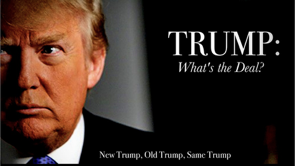
It was directed and produced by Al Levin and Libby Handros, top-flight PBS/HBO filmmakers Originally produced in 1991 when Trump was one of the richest and most famous men in America, an acknowledged billionaire. This shows the foundation for how he built his success, long before his highly-rated 14-year run on NBC, The Apprentice, or his run for President.
It’s 82 minutes. I recommend it.
The film includes people who knew him well and could prove his tactics and lack of character. 32 years ago, the only way for a film to be seen was on television or in a theater. Donald vigorously threatened to sue any broadcaster or distributor that took on the film. None did. So, it was effectively suppressed. Finally, after he ran for reelection in 2020, it was released and streamed.
Why didn’t we see it?. Would history have been different if the public knew all this before he ever ran for President in 2016, even though almost nobody (including the Donald himself) thought he could win.

All of which brings me to my decades of finding ways to get documentaries to audiences that wouldn’t see them otherwise. Image Union, on Chicago TV every week for 30+ years, starting in 1978 was first. The 90’s, a breakthrough national PBS series started in 1989 with work by some of the best out-of-the-mainstream film and video producers. We lasted four seasons, 52 hours of programs. It worked on television and was funded well enough to attract an audience and pay the creators. When the money from public television ended, so did we.
Then, in 2001, after television was surpassed by streaming and there were hundreds of ways to watch what you wanted when you wanted, we were convinced streaming on the Internet was a new way for audiences to see our established brand of nonfiction video. We raised enough money to produce an experiment, a “pilot” called imageunion.tv.
We brought in several great young people (20’s and 30’s) who chose and packaged over 200 mostly short films and videos, on a platform that combined videos, both archive and fresh-made (mostly not available on YouTube) with a sense of broadcast tv. We made selections from the vast world of available video and aimed to become a trusted place to see unique curated short pieces—primarily documentary and current imaginative animation. We did some live interviews with filmmakers and a talk show from the Billy Goat Tavern in Chicago.
We were able to stream for a fraction of the cost of existing platforms. But, we ran into the reality that however you try, an ultra-small company will never be able to compete with massive billion-dollar corporations, no matter how good the content.
Our idea had flaws, our timing coincided with the financial pressure on streaming channels, but we were on the wrong side of 21st-century corporate commercial reality.
After almost two years of developing and showing imageunion.tv, we weren’t able to build enough audience to get enough revenues to cover our relatively small costs. We folded up the tent in December. Here’s the email we wrote to our dozen or so collaborators:
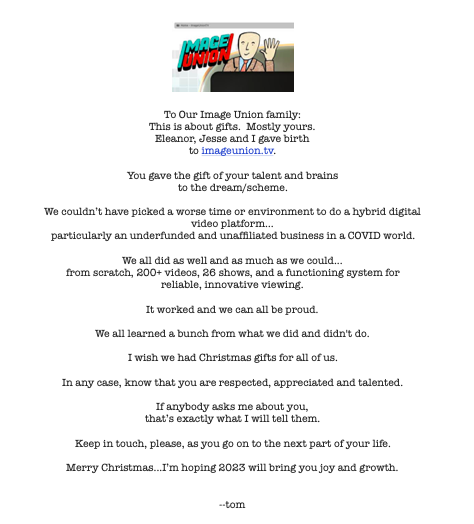
There are lots of definitions of success!
Prize-winning Supreme Court protest sign, 2022

The Kids who make it all worth while






 PY-O-MY
HAPPY THOUGHTS FOR 2023!
>