
MAYDAY
It has been a worldwide spring holiday celebration for millennia but for over 120 years the day commemorates working people. We generally hear precious little about it in Chicago where it all began. It was in Haymarket Square, now a parking lot overlooking I-94 (the Dan Ryan), just east of dozens of glitzy Randolph Street restaurants. That’s where the labor rally of 1886 was held to demonstrate in support of the 8-hour workday.
The event was peaceful until after the final speech when a bomb was detonated and police began to shoot. Seven Chicago policemen and four demonstrators were killed. Dozens were injured. In a highly criticized trial, the judge sentenced seven “anarchists” to be hanged for conspiracy, though the responsibility for the bomb has never been proven. Four were executed. One committed suicide. They have been international martyrs ever since. The three who survived were pardoned by Governor John Peter Altgeld in 1873.
Despite a plaque and small sculpture at the location of the “Haymarket Affair,” or “Haymarket Massacre,” Americans, and Chicagoans in particular, celebrate International Workers Day quietly. In fact, many people in Chicago celebrate January 26, the anniversary of the Bears’ Super Bowl XX victory more enthusiastically than May Day — different strokes, I guess.
I’m with IKE!
I wrote about this a few years ago, but I’m still struck by Dwight D. Eisenhower and his insight 60 years ago in 1961. Ike warned of the dangers of “the Military-Industrial Complex” after eight years as President and 38 years in the Army.

For the record, here are some of the stats:
- Defense spending 1961: $50 Billion (2021 value with inflation=$443 Billion)
- Biden’s Defense budget for 2021: $715 Billion.
- Second closest defense spending: China with less than one-third of US.
To me, it looks like the military-industrial complex is alive and well, despite all the proposed plans for infrastructure, families, health, etc.
We’d all do well to look back at Eisenhower’s Presidential farewell address:
…A vital element in keeping the peace is our military establishment. Our arms must be mighty, ready for instant action, so that no potential aggressor may be tempted to risk his own destruction.
Our military organization today bears little relation to that known by any of my predecessors in peacetime, or indeed by the fighting men of World War II or Korea. Until the latest of our world conflicts, the United States had no armaments industry. American makers of plowshares could, with time and as required, make swords as well.
But now we can no longer risk emergency improvisation of national defense; we have been compelled to create a permanent armaments industry of vast proportions. Added to this, three and a half million men and women are directly engaged in the defense establishment. We annually spend on military security more than the net income of all United States corporations.
This conjunction of an immense military establishment and a large arms industry is new in the American experience. The total influence — economic, political, even spiritual — is felt in every city, every Statehouse, every office of the Federal government. We recognize the imperative need for this development. Yet we must not fail to comprehend its grave implications. Our toil, resources and livelihood are all involved; so is the very structure of our society.
In the councils of government, we must guard against the acquisition of unwarranted influence, whether sought or unsought, by the military-industrial complex. The potential for the disastrous rise of misplaced power exists and will persist.
We must never let the weight of this combination endanger our liberties or democratic processes. We should take nothing for granted. Only an alert and knowledgeable citizenry can compel the proper meshing of the huge industrial and military machinery of defense with building our peaceful methods and goals, so that security and liberty may prosper together.
I like IKE on this one. I don’t mean to oversimplify. But, continuing to throw trillions at the Pentagon is not an attractive solution. Making it more efficient and actively using military assets to work for peace, rather than building and selling more bombs, missiles, drones and weapons, including chemical warfare agents, makes much more sense to me.
Lexophilia
“Lexophile” describes people who love words, frequently using them and their alignment for humor.
Two classic examples are “You can tune a piano, but you can’t tuna fish”, or “To write with a broken pencil is pointless.” An annual competition is held by the New York Times to see who can create the best original Lexophilia. Some examples:
- Police were summoned to a daycare center where a three-year-old was resisting a rest.
- I’m reading a book about anti-gravity. I just can’t put it down.
- When you get a bladder infection, urine trouble.
- England has no kidney bank, but it does have a Liverpool.
- I know a guy who’s addicted to drinking brake fluid, but he says he can stop any time.
- A dentist and a manicurist married. They fought tooth and nail.
- The guy who fell onto an upholstery machine last week is now fully recovered.
- When she saw her first strands of gray hair she thought she’d dye.
Are WE Addicted to Our Phones?

There’s an excellent case to be made. All you have to do is walk down the street anywhere in the world and see how different it is from 10-15 years ago.
Benjamin Curtis, a lecturer in philosophy and ethics at Nottingham Trent University in Great Britain addressed the question in an article originally published in The Conversation, (“Academic rigour, journalistic flair”) telling us we are losing our minds to Google:
It doesn’t seem to be good for our minds to be spread across the internet. A growing cause for concern is so-called “smartphone addiction“, no longer an uncommon problem…
But the word “addiction” here, in my view, is just another word for integration: The reason why so many of us find it so hard to put our smartphones down, it seems to me, is that we have integrated their use into our everyday cognitive processes. We literally think by using them, and so it is no wonder it is hard to stop using them. To have one’s smartphone suddenly taken away is akin to having a lobotomy.
An article from techjury.net last week calls smartphone addicts, “nomophobes.” It takes its name from “NO-MObile-PHOne-phoBIA.” It’s the fear of not having your phone with you.
Some of the findings:
- The average smartphone owner unlocks the phone 150 times a day.
- Using smartphones for longer intervals of time changes brain chemistry.
- 66% of the world’s population shows signs of nomophobia.
- 71% usually sleep with or next to their mobile phone.
- 75% of Americans use their mobile phones in the toilet.
- 20% of people would rather go without shoes for a week than take a break from their phone
- 57% of smartphone users in the US increased their smartphone usage during COVID-19, by an average of about an hour a day.
- Brazilians use their phones the most, four hours, 48 minutes every day. Chinese are second (3:03) and Americans are third (2:37)
A Correlation Engine
That’s a term for 21st century Big Brother security. It’s a suite of algorithms that trawl through a city’s historical police records and live sensor feeds looking for patterns and connections. When it finds them, it spits out a long list of possible leads onscreen including a lineup of individuals previously arrested in the neighborhood for violent crimes, home addresses of parolees living nearby, a catalog of similar recent 911 calls, photographs and license plate numbers of vehicles that had been detected of speeding away from the scene and video feeds from any cameras that might have picked up evidence of the crime itself, including those mounted on passing buses and trains. Genetec is the company that makes the system that brings all the information together (Citigraf) and it counts Chicago as one of its successes.
You get the idea: they’ve got you covered. And that’s exactly the kind of techno-danger that leads to perpetuating mistakes based on “intelligence.” It’s the kind of overboard enforcement that could lead to the police murder of Breonna Taylor and dozens of others.
Solving crimes and capturing those responsible is, of course, a function of policing. My caveat is that overuse and complete reliance on technology and combining factors are a slippery slope. It leads to wrong results –racially-linked tracking Black and LatinX men—that must be tempered by human intervention and interpretation. There’s no margin for error. Shooting (and sometimes killing) any innocent people based solely on the correlations is the kind of systemic crime that must be eliminated. Otherwise, there’s no chance to build trust and bring people together.
Brain Massage?
OK–Tell the truth…do you know what ASMR is?
Turns out there are millions of people worldwide watching and listening to videos that stimulate them almost like a brain massage. ASMR stands for Autonomous Sensory Meridian Response. Each has a trigger that many say leads to a tingling sensation experienced in their bodies from watching the video on a screen. Most are everyday things like sitting, cooking, and especially whispering.
This feeling starts in the head and moves down toward the spine when a person watches or hears particular triggers, leading to goosebumps, brain tingles, feelings of relaxation, a lower heart rate, and mild euphoria. Some who experience ASMR have described the sensation as having a “brain orgasm.” While this isn’t necessarily a sexual reaction, some people can experience sexual arousal in response to the right triggers.
I think that Whispering Jane is the most popular ASMRtist. She’s 21, from South Korea, and has 8.7 million subscribers. She earns about half a million dollars a month. You can find her here.
Yeah, there’s a whole world out there I know just about nothing about. Do you find yourself off the radar with me?
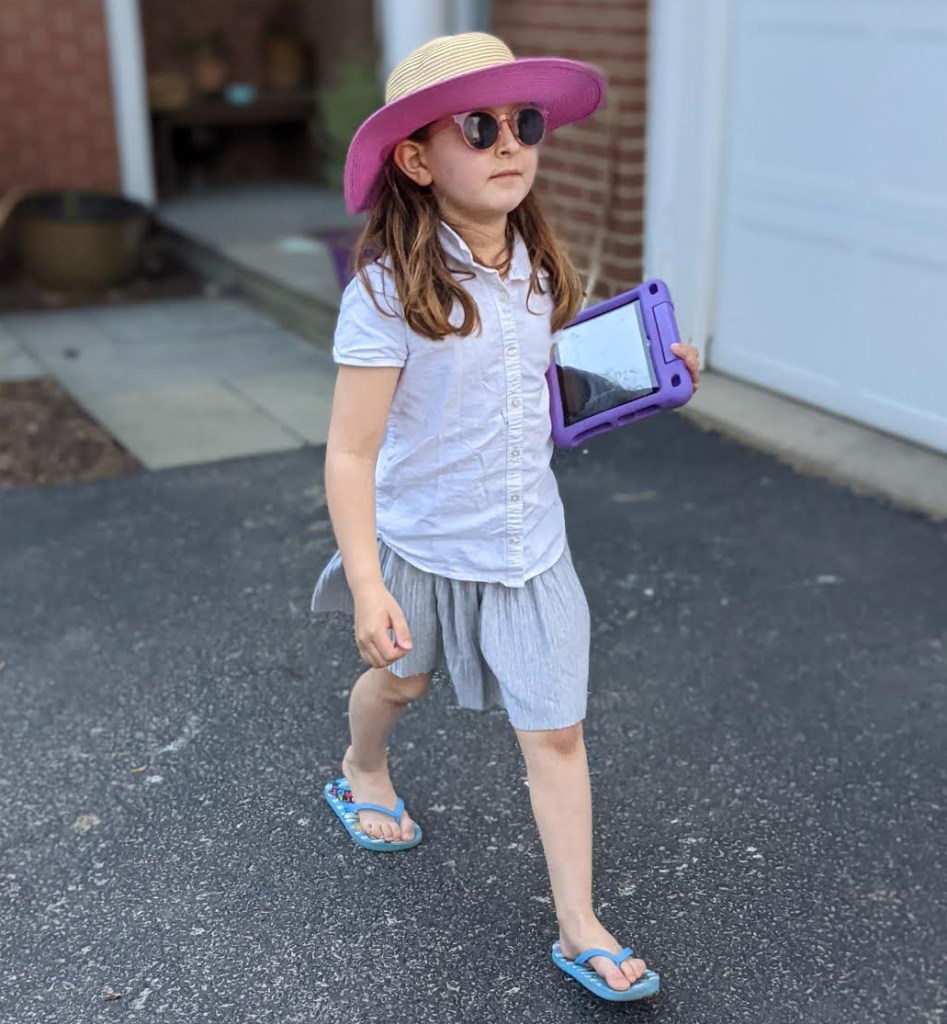
Maggie Jane Kliner parading on the first warm day of the year 
Dandy Charlie Kliner 
Oliver Palm 
Eliza Palm
Thanks for reading and replying, as usual. Enjoy the outside as much as you can in May.
-tom
 PY-O-MY
first class Py o My Tom…keep it up!
Bill Chayes
Tom (and Mary Beth):
I LIKE IKE ON THIS ONE. I don’t mean to oversimplify. BUT not worried about ASMR! Kids growing nicely, HAPPY MAY is here! Thanks, Y’all!, Warmly, —Barry
>
Tom:
The excessive use of smartphones is making us less smart and much more phony (phone-y). Dies that qualify for the lexoohilia contest??
Len