
What About Memory?
I’m obsessed with it.
Remembering moments, words and people that I tell myself don’t matter.
And forgetting what feels like does matter.
Way more than the stuff I do remember.
Denial has become a constant in my life.
It’s not just age. Look at the people we all know who are cogent in their 90’s.
We had dinner last week with an 80-something semi-retired professor, a pioneer of underwater archaeology. His friends say “He’s lost it.”
He might have, but there’s so much left.
I had never met him before. I had no expectations. When he talked about his seven brothers and sisters, naming each with comment and birth order, it felt like something that could never be lost, regardless of how much he was supposed to be. He lives in the house his great granddad built and he describes vivid memories.
He also told a beautiful story about the spiritual highlight of his life, years ago when he was in Jordan at the great ancient city of Petra and wound up alone all night then at dawn with no tourists around. “It took my mind and spirit to a place I’ve never been to before, or since.”
It was so real to him. And he made it real to all of us.
My guess is that how and what you remember when you’re old reflects how you were when you had all your marbles.
My memory is inconsistent. At this point, I have mountains of details from before I was twelve, including words to songs and ads from radio and TV. Sirius channel 005 is all songs from the ‘50’s. If asked, I couldn’t recite the words to most of the songs, but when they play, I can say them and “sing” most of them. I was six in 1950.
My memory tends toward what I’ve consumed in media, especially video. I’ve been recording people on video for fifty years. Very little from real life is more real to me than the words and images of the videos I’ve put in documentaries and TV shows. Most of them live in the Media Burn Archive, mediaburn.org. They get triggered and activated all the time.
For instance, when I read or watch something about how the disparity in income and wealth has grown in recent years, out pop two segments from a show called “MONEY MONEY MONEY” from one of 52 hours from THE 90’s, PBS series we produced from 1989 to 1992. You can watch the two segments at https://mediaburn.org/video/the-90s-episode-301-money-money-money/.
Fast forward to 15:29 for an unforgettable a capella song by Sara Ogan Gunning from Knox County, Kentucky. It was produced by Appalshop in the 1980s.
Gunning’s words are powerful, even stronger, if you watch the short video:
I hate the capitalist system
I’ll tell you the reason why.
They caused me so much suffering
And my dearest friends to die.
Oh yes I guess you wonder
What they had done to me.
I’m going to tell you mister
My husband had TB.
Brought on by hard working for low wages
And not a guarantee.
Going ragged and hungry,
No shoes on his feet.
I guess you’ll say he was lazy
And did not want to work,
But I must say you’re crazy
For work he did not shirk.
My husband was a coal miner.
He worked and risked his life.
To try to support three children,
His mother and wife.
The piece that follows is a declaration by Ed Sadlowski, a legend in the Steelworkers’ Union. We made it outside the gate of the dormant steel mills in South Chicago in 1991:
The real question is the distribution of wealth in this country, monetary and materialistic wealth. It’s not about raising unemployment benefits another $3 per week when a guy’s unemployed.
Look at the situation we have in this country and the cost of health insurance.
It’s criminal.
But, yet who’s opposing it the most?
The insurance companies that reap the harvest from the profits of their policies.
A few years ago if I said we need a national insurance program, the Lee Iacoccas would call me “communist, socialist and everything else in the world.”
He’s now on my side for a change by virtue of the fact that the cost to him [is less.]
…The real question at hand: [the companies] doing things they should have done 100 years ago. Take health insurance: Now, they see it as cutting costs…Not SHARE. To share that wealth is to share power. When you say that, they put you against the wall. They put you against the wall.
When I can remember the impact of those videos in 1991, I’m not too upset that a whole lot of stuff has drifted away. They’re as relevant now as they were then.
What Is PY-O-MY, anyhow?
It’s the company my father started in 1947 in Chicago making and selling ready-to-make food mixes and products. The first was Rice Feast. Rice was one of the only raw food materials available right after the War (WWII for those whose history classes stopped in 1941.). For the next 20 years, PY-O-MY was the little company that invented new products, mostly desserts and sold them in the stores and supermarkets across the country. The “category exclusive” didn’t last very long if the little guy (PY-O-MY) had success with them. The big guys, Pillsbury and Betty Crocker, originally flour millers, could blast the kind of boxed mixes into all stores nationwide. They didn’t have to buy the main ingredients, flour and white sugar, from anyone else.
This was the beginning of “AS SEEN ON TV” and the consumer/media culture we take for granted now. So, big companies got bigger and squeezed out the little guys with their ability to spend big bucks on TV spots. Over the 20 years my dad operated PY-O-MY, the trend intensified. When he died in 1967, the volume of manufacturing was high, but the majority of products were lower margin mixes for the private labels of food chains.
But, it was a good run, trying to stay ahead of the monsters.
Some of the PY-O-MY products were Blueberry Muffin mix (with a can of real blueberries in the box), Brownie mix in its own metal cooking tin, Coffee Cake mix with yeast included, pineapple upside-down cake mix with a can of pineapples. Ice Box Pie mix was a big one for a while (until Jell-O snuffed it). There was Puddin’ Cake, a side dish line (Macaroni & Cheese, dried Au Gratin Potatoes) and many more.
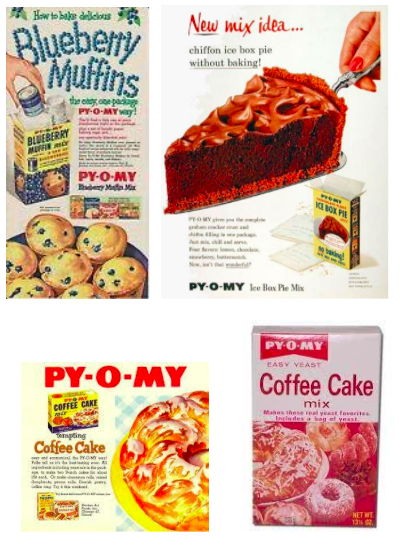
Many worked for a while and developed loyal customers.

Some were ill-conceived, (see above) but scientific marketing wasn’t happening then. My dad used to say that they had to keep inventing products to feed the monster and stay ahead of everyone else.
After his death, we sold the company to Gilster Milling, a flour company and direct competitor in the mix business. All the PY-O-MY products were discontinued except Coffee Cake which is now exclusively online.
Also Ahead of His Time
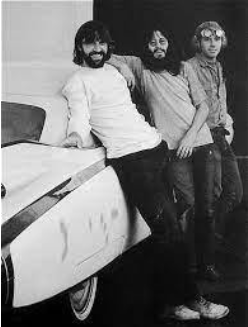
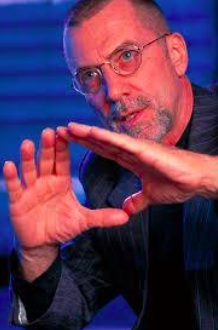
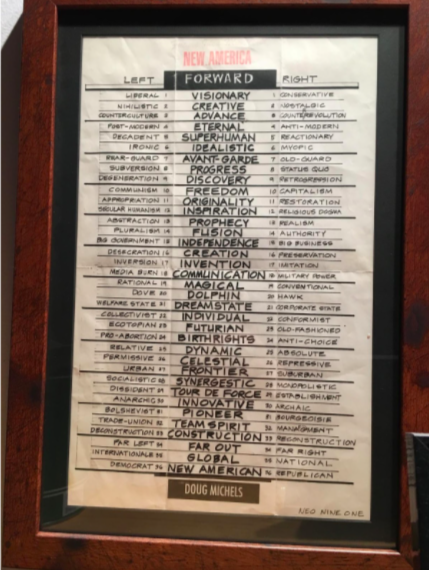
Doug Michels, cofounder of the architecture/design/video collective Ant Farm, was a dear friend and collaborator who died far too soon (at 59 in 2003.). He was known worldwide for events like Media Burn, Cadillac Ranch, the Eternal Frame and Dolphin Embassy. He had more ideas and worked harder than anyone I’ve ever known. But his ideas weren’t just design.
This is one he created in 1991 to identify the forces in our society and I’ve never seen this kind of ideological grid, before or since. His was a unique mind.
And finally, this short COVID memory from an unknown (unrelated) Internet source:

Next month, grandchildren, José Abreu and summer insights.
Meanwhile, remember to have some fun.
 PY-O-MY
TOM—
LOVELY ON MEMORY—Yours mostly from “videos,” others from books or a variety of sources.
Thanks, MUCH, for sharing detailed images from Py-O-MY products, AND, especially for BRINGING BACK DOUG and his MIND!
Appreciate you even beyond our recollections.
As always,
—Jagoda >