
MAYDAY
My first association was in kindergarten at Farm School way out in the country in Northbrook, IL. Then, it was cornfields on fertile land on a few dozen farms. Now, a suburb with some 35,000 people and a bunch of malls.
We did the Maypole with everyone in the school (about 100 of us K-5 + staff + families) grabbing hold of the long colorful strands and joyously intertwining them as we walked or skipped around the pole.
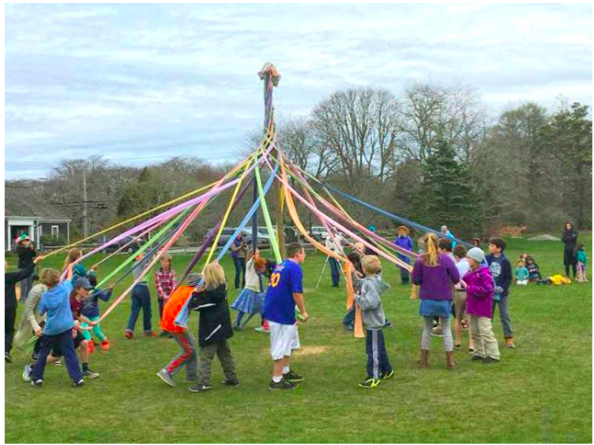
It was a fun celebration, but as a five-year-old, I had no clue that May Day was International Workers Day, originating in the 1886 Chicago demonstration for the 40-hour work week and better working conditions. Today, every country except the US and Canada recognizes its significance. Our Labor Day is mostly just a day off for a three-day weekend with barely a hint of its roots in the struggle for workers’ rights.
For many centuries the first day of May was a traditional global rite of spring, to “bring in the May” by gathering wildflowers and green branches, weaving floral hoops and hair garlands.
In 1886, it took on a far different meaning, centering around the demonstration in Haymarket Square in Chicago. It went on for three days and wound up with a bomb thrown into the crowd killing seven police officers, at least four in the demonstration, and injuring dozens.
Speculation about who was responsible for the bomb has persisted for 136 years. A fascinating book by historian James Green, Death in the Haymarket addresses how tension and resulting violence were inextricably bound to workers attaining rights in the 19th century and beyond.
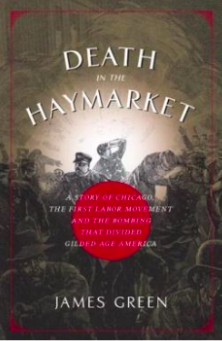
All Things Considered did a 7-minute story for May Day, 2006 interviewing the author and exploring the roots of the “riot” or “massacre” for which 200 people were arrested, seven sentenced to death and four foreign-born “anarchists” were hanged in 1888 as accessories to murder.
Eventually, they were recognized as scapegoats and pardoned by the governor of Illinois four years later.
Haymarket has been called the first American “Red Scare.” Fear of and discrimination against immigrants, and unchecked police brutality during social justice demonstrations persist to this day.
Happy May Day.
The Wobblies
More Labor History. I listened to Studs Terkel waxing about the significance of the IWW (International Workers of the World) for years. The Wobblies were an important force for organizing workers by industry rather than by jobs. They wanted “one big union” and for all workers everywhere on earth to be united as a social class to supplant capitalism and wage labor with industrial democracy.
Its peak was 1917 with some 250,000 members, many women, and minorities. It split into socialists and anarchists and was in conflict with the American Federation of Labor (AFL) as well as the federal government which saw them as a threat.
In a way, their principles surfaced with the Congress of Industrial Organizations (CIO) which merged with AFL in 1955.
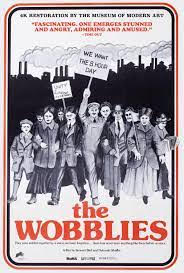
The Wobblies, a 1979 documentary, has just been remastered and selected for the Smithsonian Archive of important films. It will be re-released today coinciding with May Day. The preview/review from Democracy Now is here.
Learning from Our Old Observations
Most of you know my penchant for looking at informal and personal media—written or visual—to understand what was happening at the time, rather than pursuing traditional historical sources. It’s a terrific way to context contemporary events and thinking. That is part of the reason I’m committed to video archives created by “regular” people, outside the mainstream.
I have the same motivation to revisit PY-O-MY Letters/Weinberg House Organs, both mine and my dad’s, to get a fix on what was on our minds that we felt important to articulate, from the 1950s to the 21st century. I’ve got a few examples of our writing from past May Days:
In May 1959, Lou Weinberg mailed out a ten-page booklet with the House Organ. Titled OUR RED RIVALS: A Penetrating Report on why the Soviet People feel they will ”catch America.” Written by Harold Mansfield, a public relations officer of the “Boeing Airplane Company,” it starts out with
“The Soviet Union has challenged America to an all-out economic competition in the years ahead. After that, it claims the communist system will gain world acclaim and will prevail.
…Nikita Khruschev, head of the Communist Party said ‘The principal feature of our effort is the emergence of socialism from the confines of one country and its transformation into a world system. The internal forces of the capitalistic economy are working toward its downfall, while the Communist economy is steadily rising toward its goal of proving itself to the world and transforming itself into a world system through peaceful competition.’
Mansfield concludes after spending time in the Soviet Union,
“Not one Russian believes his country will remain behind America industrially.”
The more things change, the more they stay the same!
Vladimir Putin was seven years old when this was written.
Skip to May 1964. Dad listed the cars that sold the most in that year. I’m not sure what it says about changing times, but I found it curious. Maybe you will too.
| Make Cars | Sold in 000’s |
| Chevrolet | 506 |
| Ford | 292 |
| Pontiac | 162 |
| Rambler | 128 |
| Oldsmobile | 122 |
| Chevelle | 104 |
| Falcon | 102 |
| Buick | 86 |
| Fairlane | 85 |
| Dodge | 78 |
Thunderbird was at the bottom of the list at 21st with 36,000 sold. The MSRP in 1964 was $4500. Now, as an antique, they sell for $9000-32,000. $4500 in 1964 would be $41,000 with inflation.

May Day, 2015. I wrote bout the newish concept of inequality:
THE ONE PERCENT
Everybody now knows about “The 99 percent and the 1 percent.”
Even though ideas about income and wealth inequality have been bandied about for decades academically by social scientists, critics, and other wonky types, they didn’t get embedded in all of us until 2012. That’s when it was made famous by the Occupy “movement.”
“The One Percent” is a phrase that stuck. Just like “Kodak Moment,” “Wall Street vs. Main Street,” and “The Tea Party.” Everybody knows what the One Percent is…or at least that there really is one.
What we didn’t know for sure was whether “The One Percent” was just a commie-pinko conspiracy or whether it was substantive fact behind it. Recently I came across a wonderful piece of animated video that made me think about it in a new way. Some would see it as stilted left-wing blather. I think it’s a great use of animation to get an idea across. My (“FDR was a Commie”) grandfather would have called it propaganda. And maybe it is.
It’s on Upworthy.com, the intentionally provocative site that, in this case, is living up to its motto on the home page: Things that Matter. Pass ‘em on.
Maybe you’ve been checking out Upworthy since it was started just over two years ago by Eli Pariser, 30, a major moving force behind the phenomenal success of MoveOn, and Peter Koechley, 33, former managing editor of the Onion.
A March New York Times story quoted the founders saying their mission “is to host the intersection of the ‘awesome’, the ‘meaningful’ and the ‘visual.’
They designed it to go viral. And it has succeeded. Fast Company called it “the fastest-growing media site of all time.”
So, here’s the six-minute video from Upworthy that sets out to prove that 99% of Americans don’t have a clue how much wealth the 1% owns.
I haven’t read Thomas Piketty’s hot-selling book, Capital in the Twenty-First Century, but I refuse to believe that income inequality is an economic constant. Intuitively, it doesn’t make long-term sense.
Maybe, like quite a few questions raised in the House Organ, the one percent/99 percent question is a SO WHAT?
But for me, the video brings home a point and is remarkable, both for the message and the way the medium is used. What do you think?
Now, seven years later, income inequality has gone bonkers. How else can you explain that one guy who left South Africa as a kid could spend $44 Billion (about $13 Billion in debt) to buy all of a company.
Report from Three Months Online

Our streaming video channel is on 24/7 and it works just fine technically. Our viewers deem it a success. But, it’s crowded out there in the videosphere and we’re outgunned by the corporate goliaths. We are stubbornly hanging on, showing hundreds of unique videos and developing plans to reach the global audience we know would watch imageunion.tv if they knew how cool it is.
One original goal was to bring nonmainstream American creative sensibilities to people all over the world and simultaneously deliver programming from artists and producers outside the country whose work is seldom or never seen here. Like so many ventures, getting to this goal has taken way longer than we originally hoped.
IMU-TV has received thousands of views from at least 40 countries including India, Great Britain, France, Germany, Japan, Canada and the Philippines. About two-thirds of the audience is in the United States. We haven’t gone viral yet. And we need to maximize social and digital media outreach to build an online audience. Nobody said it’d be easy! I’m proud of our tiny team for accomplishing what many warned would be impossible.
Our analytics show that when they find our channel, viewers on average spend two hours watching. They like it.
It’s a whole different game from broadcast television in the 1990s when our independent shows could get over a million viewers by being aired on PBS stations.
We haven’t figured out how to generate the revenue we need. The MyPillow guy struggled for six years before he started blanketing the airwaves with infomercials. The company now spends less than $100 million on advertising and sells more than $300 million in (overpriced) products. His net worth has gone from zero to an estimated $300 million in less than a decade.
Our little company needs a different revenue-generating model for this decade. People under 30 usually don’t have a TV and use their phones, computers, or iPads for watching video. The growth vector and economics of digital media are vastly different in today’s world.
Please take a look at imageunion.tv And tell your email and social media friends to check it out and to pass the word around. It’s still free! Thanks
All in Our Family
Every spring, the story of how the ancient Jews escaped from slavery in Egypt is told at a family gathering for Passover seder. In a way, it’s a backstory to the organizing for workers’ rights that is the heart of May Day. It’s a celebration that spans generations.
We had five grandchildren at the 2022 family seder, all under 8.




Here’s hoping your May Day and the whole month brings wild flowers and fun with family. We all can sure use it in the uncontrolled uncivilized times of more COVID and the destruction of Ukraine.

p.s. For many years, Roger Wallenstein, my homie and main man since we were seven or so, and the dear of dears, Judy, hosted our extended family seder. Always, when we needed some comic relief during the service, we got it big-time from Jeff Glazer. He was funny, generous to a fault, and wonderful to his family. He collapsed and died instantly in early April. So many of us miss him and his quick-biting wit.
 PY-O-MY
I have no idea – this is a pain – I have enjoyed reading your posts – but i…….
>